
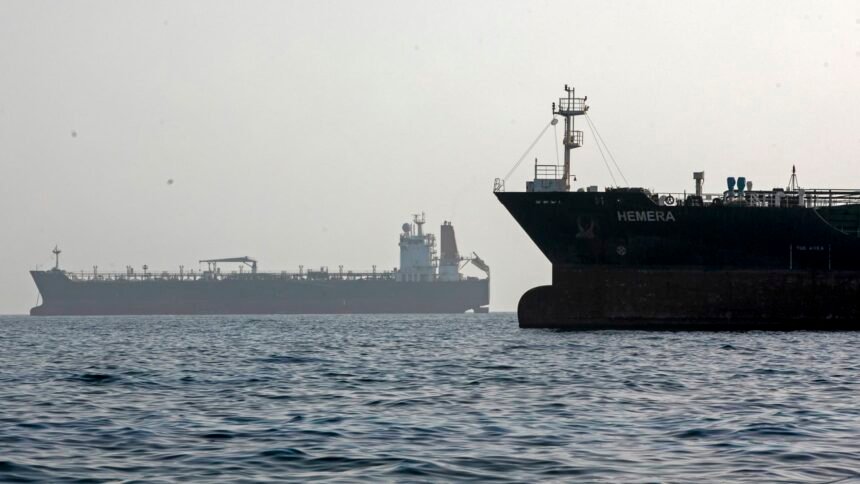
President Donald Trump said Saturday that a peace deal with Iran that would reopen the Strait of Hormuz has been “substantially negotiated” and will soon be announced, a development that could end a conflict that has choked global energy markets and pushed U.S. inflation to its highest level in years.
Trump said in a social media post that he spoke from the Oval Office with the leaders of Saudi Arabia, the UAE, Qatar, Pakistan, Turkey, Egypt, Jordan and Bahrain, as well as Israeli Prime Minister Benjamin Netanyahu, all focused on finalizing terms with the Islamic Republic of Iran.
“An agreement has been substantially negotiated, pending finalization between the United States, the Islamic Republic of Iran, and various other countries,” Trump said in the post.
“The details of the agreement are being discussed and will be announced soon,” he said, which also includes reopening the Strait of Hormuz, vital to global energy trade.
The agreement under discussion includes a memorandum of understanding as a first step, ahead of broader talks within 30 to 60 days, Iran’s Foreign Ministry said on Saturday.
Nevertheless, clear differences between the two sides appeared to remain.
According to the latest exchange between Iran and the US, the Strait of Hormuz will remain under Iran’s management, Iran’s Fars news agency reported. The report dismissed Trump’s announcement of reopening the strait as part of a “largely negotiated” agreement as “incomplete and Inconsistent with reality.”
Trump also failed to mention any deal on Iran’s nuclear program or its highly enriched uranium, both of which his administration has repeatedly said are crucial to ending the war. Iran has sought to postpone nuclear talks until a formal cessation of hostilities.
Any announcement from the Trump administration may be delayed after a security lockdown was imposed after gunshots were heard very close to the White House.
Earlier Saturday, Financial Times informed That a potential deal would establish a framework for nuclear talks, ease sanctions on Iran and free up Tehran’s foreign assets.
A fragile ceasefire has been in place since April 8, amid clashes between the US and Iran on the Strait of Hormuz. The conflict has led to what Gulf countries have called the worst global energy crisis in decades, with high energy prices in the US fueling rising inflation and expectations that the Federal Reserve may need to raise interest rates.
Pakistani and Qatari negotiators held talks with Iranian counterparts on Thursday and Friday, while the US envoy remained in regular contact with Steve Witkoff, the FT reported.
Iran’s top negotiator told his Pakistani counterpart that Iran will not compromise on its “legitimate rights” and expressed distrust of the US, Reuters reported on Saturday.
Iran’s parliament speaker Mohammad Baqer Qalibaf said Iran’s armed forces have rebuilt capabilities damaged since the beginning of the conflict in late February, according to Reuters.
A major sticking point has been Trump’s demand that Iran surrender its enriched uranium and permanently abandon any nuclear weapons capability.
Trump has also demanded Iran destroy the Natanz, Fordow and Isfahan nuclear sites, which were bombed by the US last June after Israel joined the war against Iran in the first phase of the conflict.
Iran’s Foreign Ministry said the two sides remain “too far and too close” to an agreement, noting that the US has put forward “contradictory positions at times”.
Trump said Monday that the United States has refrained from striking Iran again this week while “serious conversations” are underway.
Gulf countries including Saudi Arabia, Qatar and the UAE have urged Trump to suspend military strikes, fearing Iranian retaliation against the region and further damage to global energy markets.
This story is developing. Please check back for updates.