
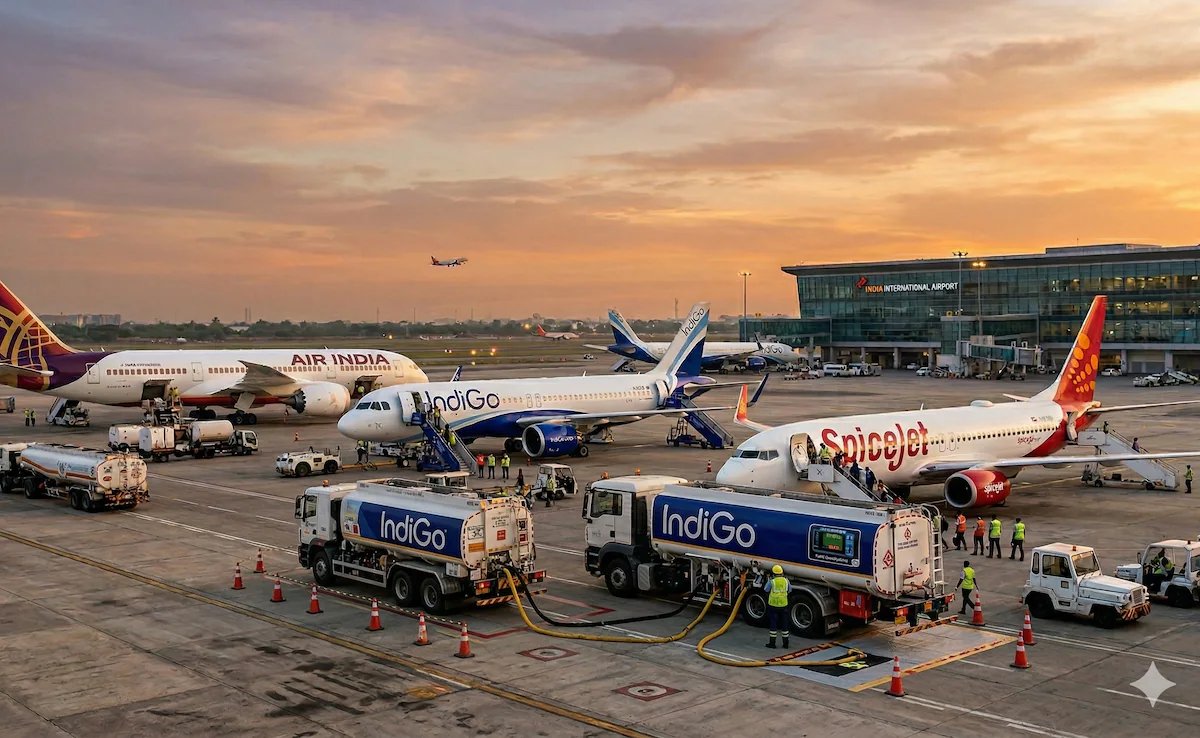
The Middle East crisis has rung alarm bells in India’s aviation sector with many airlines raising concerns that they are on the verge of “stopping operations” due to high fuel prices. At least three airlines including the Tata-owned Air India have asked the government to revise the price of aviation turbine fuel (ATF), which adds to about 40 per cent to an airline’s operating cost.
“… Any ad hoc pricing (domestic vs international) and/or irrational increase in the price of ATF will result in insurmountable losses for airlines and will lead to grounding of aircraft, resulting in cancellation of flights,” the Federation of Indian Airlines (FIA) said in a letter to the Civil Aviation Ministry.
The FIA represents Air India, IndiGo and SpiceJet.
“In order to survive, sustain and continue operation, we request your urgent intervention for immediate and meaningful financial support to tide over the current situation,” it said in the letter dated April 26.
Flights operating on long-haul routes are the most affected, the federation said. For relief, they asked the ministry to use a fuel pricing method that’s uniform across both domestic and international operations – as was done in the past with what is called a “crack band”.
“Crack band” refers to a mechanism of ATF pricing that stops extreme differences between the price of crude oil and refined ATF.
The government limited the hike in ATF price to Rs 15 per litre for domestic operations, but for international operations, it rose by Rs 73 per litre.

Another relief sought by the airlines is a temporary deferment of excise duty on ATF, which is 11 per cent.
“With the abnormal increase in ATF prices from the pre-crisis period, adding rupee depreciation to the increased prices, the 11 per cent excise duty also increases manifold for the airlines and adds to the ATF price as a big impact on airlines,” the federation said.
The concerns raised by the domestic airlines are a direct result of the US-Iran war and Iran’s blockade of the Strait of Hormuz shipping lane, from where about a fifth of the world’s oil passes.
Tankers traveling through the strait, which is bordered in the north by Iran, carry oil and gas from Saudi Arabia, Kuwait, Iraq, Qatar, Bahrain, the UAE and Iran. Most of that oil goes to Asia. Any disruption to traffic through the strait is highly disruptive to the oil trade.