

image source, @AITCofficial
published
Reading Time: 6 minutes
Politics has never been easy for the opposition in West Bengal.
When Congress was out of power in West Bengal in 1977, it has not been able to return till date. The Communist Party of India-Marxist (CPM) was voted out of power in 2011 and has not been able to recover till date.
Now Trinamool Congress was out of power this year and the party is facing an existential crisis.
Many MLAs and MPs of Mamata Banerjee’s party have separated from her. The rebel group has made itself the leader of opposition in the assembly.
It is being claimed that out of 28 TMC Lok Sabha MPs, 20 have become rebels. Some Rajya Sabha MPs have also resigned from the party and as MPs.
Amidst this crisis, Mamata Banerjee has met senior Congress leader Sonia Gandhi.
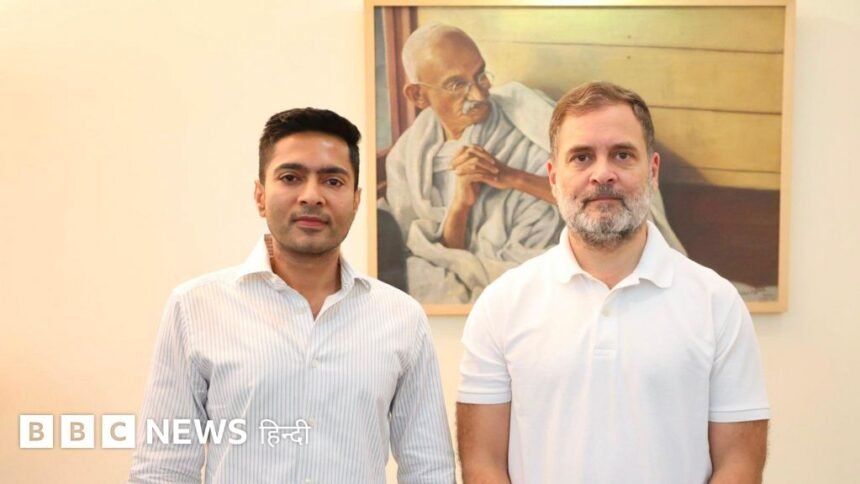
TMC General Secretary and Mamata Banerjee’s nephew Abhishek Banerjee has also met Leader of Opposition in Lok Sabha Rahul Gandhi.
Citing these meetings, reports started appearing in the Indian media on Wednesday that TMC may merge with Congress. However both parties have denied this.
Congress leader Jairam Ramesh on Wednesday written on x“The claims being made in some media reports about the meeting between Sonia Gandhi and Mamata Banerjee are completely wrong. This meeting took place in a very cordial atmosphere. There have been personal and political relations between the two leaders for a long time, hence many personal topics were also discussed during the conversation.
TMC MP Kirti Azad has said that he cannot say anything on the news of merger and only the top leadership of the party can tell about it.
Senior Congress leader in West Bengal Adhir Ranjan Chowdhury said that he was not aware of any merger or any such proposal, but he indicated that the attitude of Trinamool Congress seems to have changed after the political shocks in West Bengal.

image source, @AITCofficial
What are the experts saying?
Adhir Ranjan Choudhary told news agency ANI, “I am not an astrologer. I have no knowledge of any merger or any such discussion in Bengal. If a formal decision is taken on any issue, we will definitely be taken into confidence.”
Commenting on the current situation of Trinamool Congress, Adhir Ranjan Choudhary said, “You all can see that the party seems to be scattered. Senior leaders of the party are going here and there.”
He said sarcastically, “For so many years he did not feel any need to meet Congress leaders. But now perhaps he feels that he should meet Congress leaders.”
This statement of Adhir Ranjan Choudhary has come at a time when political speculation is intense regarding the meeting of Sonia Gandhi and Mamata Banerjee and possible new equations are being discussed in opposition politics.
Senior journalist and author Sayantan Ghosh, in his comment on the news of merger, has written on X, “Not very good news is coming from Delhi for West Bengal Congress. Sooner or later, large-scale defection is certain to take place in the West Bengal Pradesh Congress. Congress to TMC. After TMC, NCP and now there is talk of merger. I have been saying earlier also that the politics of Bengal is hardly as interesting as it is anywhere else. “Political journeys here never go in a straight line.”
Senior journalist Saba Naqvi has written, “If the merger of Congress and TMC takes place, it could give TMC a bigger role in national politics by emerging from the state of disarray and decline in the state, especially by aligning with the Congress on issues like decline in democracy.” This can also be beneficial for Congress, as it will get access to TMC’s large vote bank. But this will not be good news for Adhir Ranjan Choudhary, who has a big influence in the shrunk Congress politics in Bengal.
Saba Naqvi has written, “Even the left parties will not like this.” He was working on this strategy for a long time to first weaken Mamata Banerjee and then challenge BJP. He hoped that after the weakening of TMC, he would be able to fill the void in opposition politics.

image source, getty images
Who will benefit?
Senior journalist and writer Veer Sanghvi considers the merger of TMC-Congress a useless idea.
by Veer Sanghvi The Print It is written, “Congress is not going to get any significant benefit from TMC. Mamata Banerjee has probably never been as unpopular as she is today.
Sanghvi has written, “In such a situation, why should Congress not make a new beginning and try to gain a share of the anti-BJP political space? Why should he take the burden of Mamata Banerjee’s unpopularity? Can any party successfully align with Mamata Banerjee? His greatest strength as a leader is also his greatest weakness as an ally. She herself is a center of power and has never been answerable to anyone.
“Even when she was in Congress, she clashed with almost everyone. Even when he joined hands with BJP, he had controversies there. When she again came into alliance with Congress, her biggest contribution was that she weakened the Bengal Congress organization by motivating Congress workers to join TMC.
“Third, let us also assume that Mamata Banerjee would have been a leader with whom everyone could easily adjust, and not a combative and unpredictable political personality. Still, can you imagine that a leader, who has maintained supreme political control in her state for three terms, would willingly accept party discipline and obey the Congress President?
“There is probably only one person in the Congress for whom Mamata Banerjee really has respect and that is Sonia Gandhi. But even when TMC and Congress were allies, Sonia Gandhi did not have much influence on Mamata Banerjee. Mamata Banerjee does not listen to anyone when the decisive moment comes.

image source, getty images
Why did Mamata separate from Congress?
After the country’s independence, Congress remained in power in West Bengal till 1977, but due to the refugee crisis and Naxalite movement, cracks in the party started increasing.
Leaders like Priyaranjan Dasmunshi and Somen Mitra had also made a concerted effort to strengthen the Youth Congress against the Left Front, but Indira Gandhi declared emergency and this gave a decisive lead to the Left parties.
The Congress made a minor comeback in 1982 with 49 percent of the vote, but internal differences weakened its strength.
The real turning point came in 1998. Youth Congress chief Mamata Banerjee rebelled against the party’s alleged soft attitude towards the Left parties.
The Sitaram Kesri-led Congress was inclined towards pro-Left alliances during the initial UPA era.
In 1992, Soman Mitra had won the post of West Bengal State President by a very narrow margin but the rise of Mamata soon overshadowed him.
Although Mitra had the support of Kesari and Pranab Mukherjee. In January 1997, Mamata was expelled from the Congress due to ‘anti-party’ comments.
Last year, former West Bengal Congress President Pradeep Bhattacharya had said in an interview to Hindustan Times that Mamata was very unhappy with her expulsion and the Congress has not been able to recover from her expulsion till date.
In 1998, Mamata Banerjee founded the Trinamool Congress, which stood against both the Left parties and the Congress.
Congress had won 82 seats in the 1996 West Bengal Assembly elections but in 2001 it was reduced to only 26 seats.
After leaving Congress, Mamta became more aggressive. Mamata Banerjee, whom Congress expelled from the party, formed an alliance with Trinamool Congress in 2001 and won only 26 seats.
In 2011, Congress took the help of Mamata’s wave as its junior partner and won 42 seats.
This partnership broke again, due to which Congress formed an alliance with the Left parties in 2016 and won 44 seats. But by 2021 it was wiped out.
There was an alliance between Congress, CPIM and ISF in the 2021 elections but only ISF got one seat. This happened for the first time that the Left party and Congress did not get even a single seat.
From 1947 to the 1990s, the politics of West Bengal was primarily a battleground between the Left and the Congress. But the 2010s changed the equations.
Published by Collective Newsroom for the BBC.