
The Paraguay team made a spectacular comeback in the South American qualifiers and secured a place in the 2026 World Cup. From being an indifferent team, without talent and with few personalities to highlight, it became a brave team that was strategically organized, patient and courageous when it made up its mind.
Much of the credit goes to the man who will be on the field of play, but on the other side of the white line: Gustavo Alfaro. The coach, who left the Costa Rica team against the so-called Guarani, will coach in his second World Cup, after the experience with Ecuador at Qatar 2022. And even though that journey ended before its time, there are miles on its resume that will surely translate into learning.
Alfaro quickly brought his style to the Paraguayan team. There is no aggressive gluttony, unbridled attacks or high doses of tactical rebellion, but there is a lot of order, strategic discipline and personality at the service of the team. Everything seems designed. This, combined with the elite aerial game that is in Paraguay’s DNA, makes them a very difficult team to beat, and anyone who tries to go out and get past them may find themselves faced with a lethal counterattack.

When he arrived in October 2024, the Guarani looked like a team that knew they had been eliminated from the qualifying rounds, and his appointment seemed like an attempt to right the ship by 2030 rather than save it from shipwreck by 2026. But it had such an immediate impact – six wins, five draws and a defeat against Brazil – that they qualified directly for the World Cup.
Since then, they have struggled to find the same consistency in friendly matches, but we already know that those games sometimes serve a more important purpose than the result. In fact, it does not seem random that the Paraguayan team has faced Asian, European and CONCACAF teams before the tournament, but rather a deliberate attempt to measure itself against different concepts and styles of play.
We have already said that Paraguay’s strength lies in its overall form, but it also lies in individual talent. The most notable case is that of Julio Enciso, a player who is only 22 years old and had a good season at the surprising Racing de Strasbourg in France.

The man born in Caguas can occupy several positions in attack, either as a winger or as a midfielder, almost always starting on the left, because with his skillful right foot he faces the center and has the key to unlock the opponent’s defense. He is not a scorer, but a skilled dribbler who understands that his main task is to replace the center forward on duty.
This season he played 42 games in all competitions, scoring 12 goals and nine assists.
The list of key players starts from the last line, led by an already historic central marker such as Gustavo Gómez. A winner of everything with Brazilian Palmeiras, he is the voice of command in the background, and his good performances in one-on-ones and superiority in aerial play make him very important to Alfaro. Plus, it has a goal.

From England comes a multifunctional piece: Diego Gomez. The Brighton midfielder can play in almost any position from midfield to midfield. The most common is that he starts in the central circle, with the dual function of breaking through the defense and supporting the attacking play, but he can also play at the edge of the attack in a 4–4–2 scheme or in a 4–3–3.
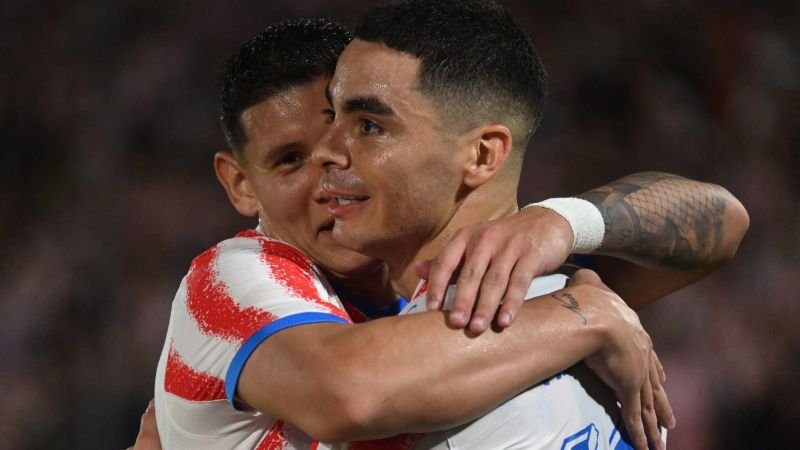
He may not have the sparkle of his best years at Newcastle, but Miguel Almiron still has ink on his left hand. Now 32 and at Atlanta United in MLS, he still has some of the electric bursts that delight St James’ Park. More mature and better surrounded today than at other times in Paraguay, he can be an important part in attack, either as a second striker or as a left midfielder.
The biggest absence from the team is midfielder Mathias Villasanti, who has been unable to fully recover from a knee injury that has kept him from playing a single game this year. Alfaro waited for him as long as possible, knowing he was a reliable piece as a starter or replacement during the South American qualifiers, but eventually his inactivity prompted the coach to look for a replacement, which he found in Isidro Pitta, who plays for Red Bull Bragantino in Brazil.

What are the United States and Paraguay’s numbers in the World Cup?