
In car wholesaling (company to dealer) in January 2026, Maruti Suzuki maintained its clear market leadership with sales of 1,74,529 units.
We have seen many new arrivals and changes over the past several months, which have been well received in the Indian market and have had a positive impact on sales in the first month of the new calendar year. Car sales in January 2026 started with a growth of 12.7% at 4,52,589 units, up from 4,01,538 units sold in January 2025. On a month-on-month basis, car sales also increased by 12%, reaching 4,04,231 units sold in December 2025. These figures represent dispatches, which are bulk shipments from OEMs to company dealerships.
Car sales 26 January – Maruti Suzuki leads
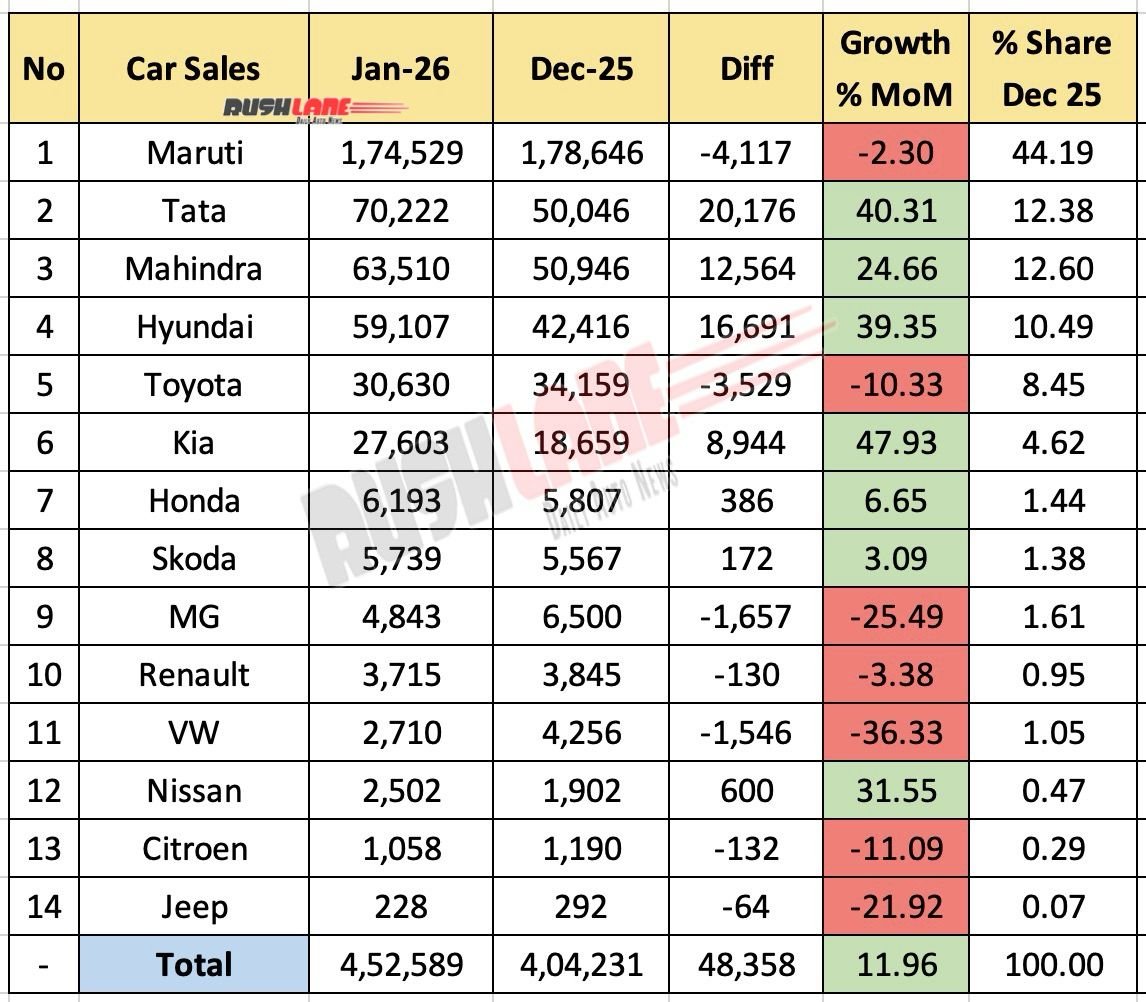
Maruti Suzuki continued its leadership position with sales of 1,74,529 units last month. While this was a marginal 0.5% growth from 1,73,599 units in January 2025, month-on-month sales declined by 2.3% compared to 1,78,646 units in December 2025. Tata Motors managed to overtake Mahindra’s sales to grab the second position in this list with sales of 70,222 units, which is a clear volume increase of 6,712 units compared to the latter. Tata Motors sales were up 46.1% at 48,075 units in January 2025, the highest year-on-year growth rate among major OEMs.
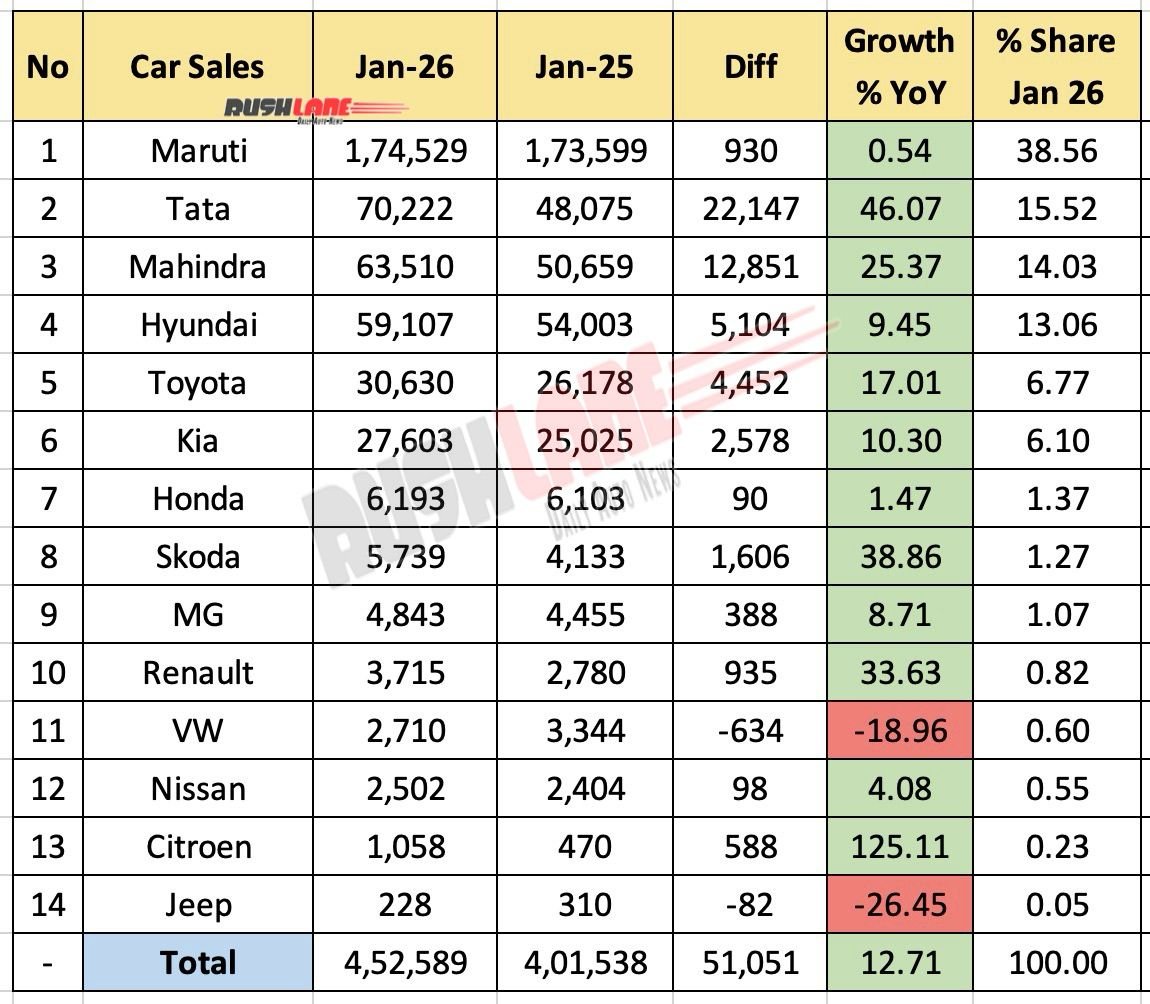
At third place was Mahindra, which saw sales grow by 25.4% year-on-year to 63,510 units, while month-on-month saw a growth of 24.7% from 50,946 units, driven by increased demand for its Scorpio/N. Hyundai has also seen positive growth with 9.5% YoY and 39.4% MoM growth to 59,107 units in January 2026. These sales were led by both the Creta and Venue SUVs.
Toyota Kirloskar Motor sales improved by 17% to 30,630 units in January 2026 from 26,178 units in January 2025, while its sales declined by 10.3% from 34,159 units in December 2025. The new Seltos has helped Kia register wholesale sales at 27,603 units, up 10.3% from 25,025 units. While MoM sales were also higher by 47.9% compared to December 2025 at 18,659 units.
Car brands with sales less than 10 thousand
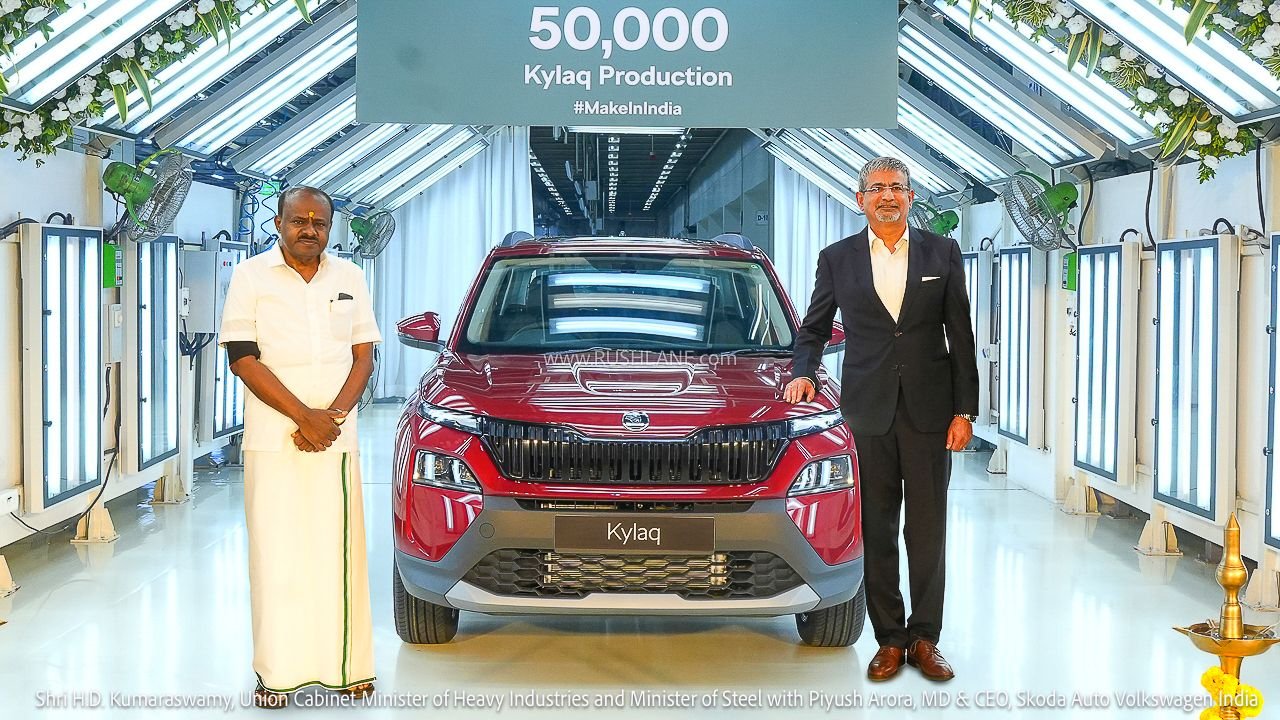
At the bottom of the sales chart were automakers with sales of less than 10,000 units. Honda’s sales increased by 1.5% YoY to 6,193 units and its MoM sales increased by 6.6%. Skoda Auto sales also ended positive at 5,739 units both on YoY and MoM basis, while MG Motor sales, while it grew 8.7% YoY to 4,843 units, saw a deep decline of 25.5% from 6,500 units sold in December 2025.
Renault recorded a positive performance last month with sales of 3,715 units, a growth of 33.6% YoY, while MoM sales declined by 3.4%. Volkswagen saw a sharp decline in sales in January 2026 to 2,710 units. This was a 19% YoY and 36.3% MoM decline. Nissan, on the other hand, recorded strong sales of 2,502 units, up 4.1% YoY and 31.5% MoM. Citroen has seen the highest growth of 125.1% year-on-year, rising from 470 units to 1,058 units. However, MoM sales declined 11.1%. Jeep sales fell to 228 units, registering a decline in both YoY and MoM.
Maruti’s market share decreased to 38%
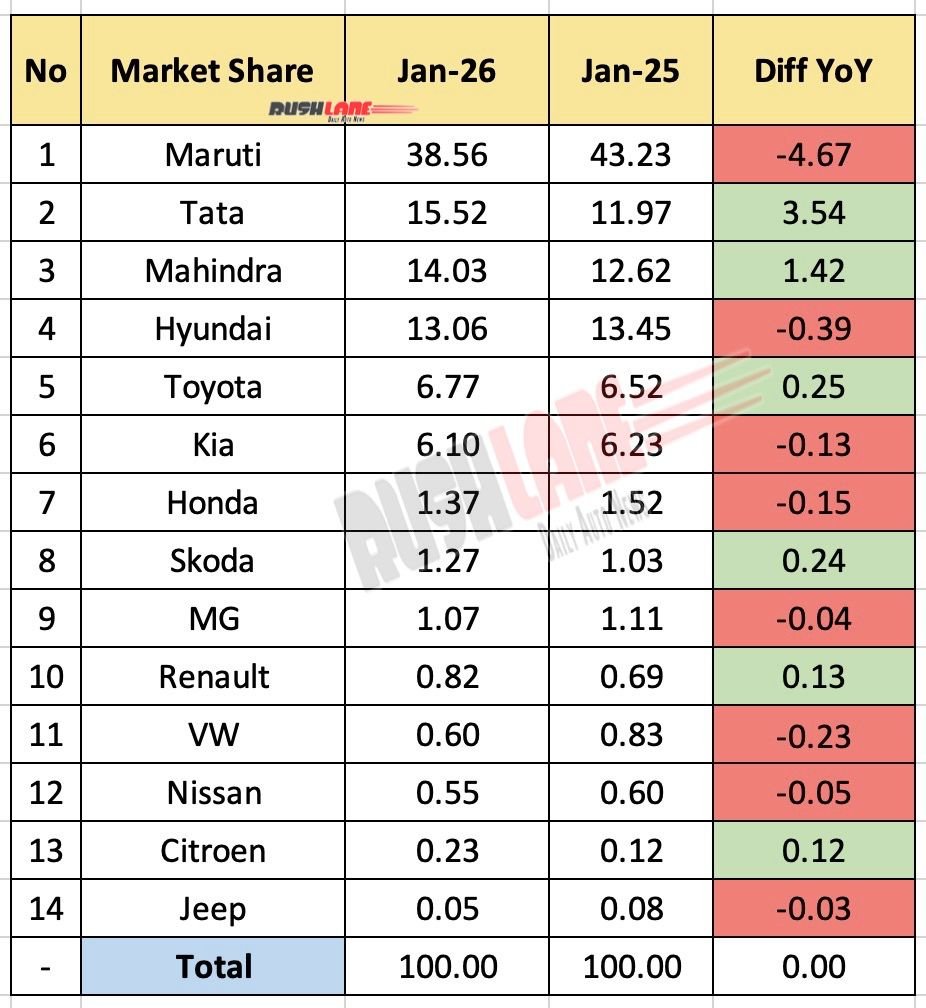
January 2026 car OEM market share data highlights a gradual but clear shift in India’s passenger vehicle landscape. Maruti Suzuki continues to dominate with 38.56% share, but a year-on-year decline of 4.67 percentage points indicates growing pressure from rivals and a more fragmented market than a year ago.
Tata Motors emerged as one of the biggest gainers, consolidating its No. 2 position with a sharp rise of 3.54 percentage points to 15.52%, reflecting strong traction for its SUV and EV portfolio. Mahindra also strengthened its growth trajectory, increasing its share by 1.42 percentage points to 14.03%, mainly driven by continued demand for its SUVs.
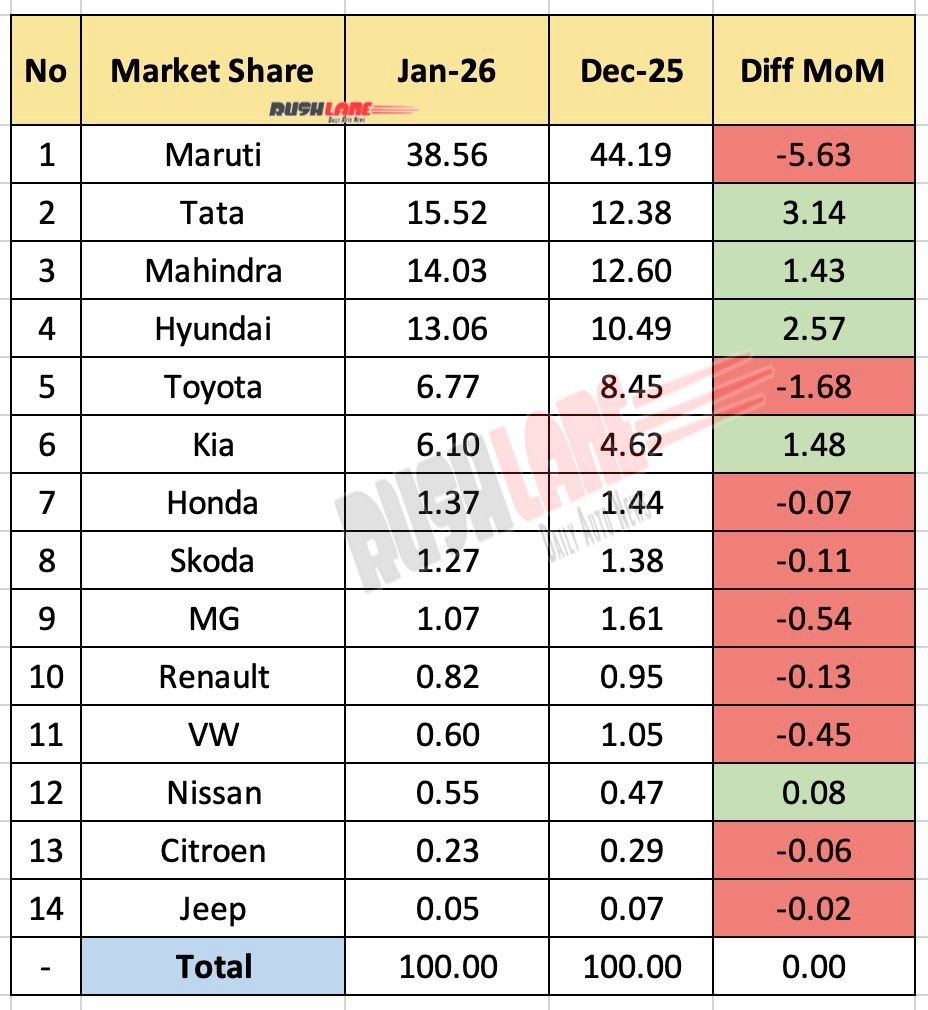
Hyundai remained relatively steady at 13.06%, with only a slight decline, indicating stable volumes despite increasing competition. Toyota showed incremental improvement, reaching 6.77%, led by sustained demand for its SUV and MPV range. However, Kia, Honda, MG and VW saw slight year-on-year declines, indicating flat growth or selective pressure in their respective segments.
Among smaller players, Skoda and Renault recorded modest gains, while Citroën, although still on a low base, doubled its market share highlighting gradual expansion. Overall, the data outlines a market where leadership remains intact, but growth is increasingly being captured by Tata and Mahindra, indicating a continued shift towards SUVs and electrified models.