
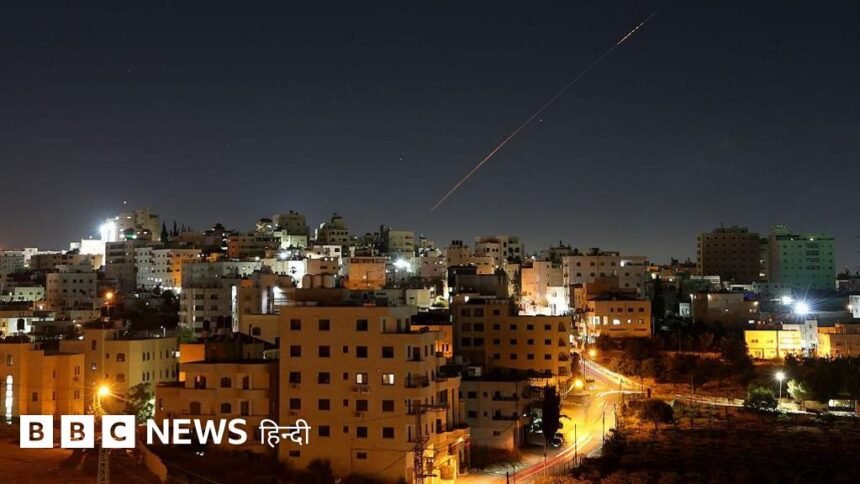

image source, AFP via Getty Images
Reading Time: 7 minutes
The IDF says that Iran has again fired missiles towards Israel. In a statement it said that defense systems are working to stop the threat.
The IDF has appealed to the people to move to safe places if they receive any alerts.
Earlier on Sunday, Iran had fired several missiles at Israel. In response, Israel has also attacked Iranian targets.
“Shortly ago, the Israeli Air Force attacked military targets of the Iranian terrorist regime in western and central Iran,” the Israel Defense Forces (IDF) wrote on Telegram.
It did not provide any further information about casualties or the exact location of the attacks. But Iran’s government TV channel has given news of explosions in three cities.
“Multiple explosions were heard in Tehran, Tabriz and Isfahan,” state TV posted on Telegram. According to reports, explosions were also heard near the central city of Karaj.
Iran’s local media report that the urban areas of Tehran have not been targeted in Israel’s attack on central and western Iran.
Citing Tehran’s fire department, local media reported that at least two explosions were heard in the western parts of the Iranian capital early on Monday.
Government media quoted local officials of Isfahan as saying that there were no casualties in the attack. No information has been received about other parts of the country.

image source, @IAFsite
Meanwhile, some time ago the Israeli Army has said that more missiles have been fired from Yemen to Israel.
The army said air defense systems were “working to deter the threat.”
According to ‘The Times of Israel’ report, warning sirens are sounding in Jerusalem, Tel Aviv and areas around central Israel.
Earlier, Iran’s Islamic Revolutionary Guard Corps (IRGC) said in a statement that these attacks were a warning.
The IRGC said it marked the beginning of a “week-long sustained offensive”.
This attack from Iran took place when Israel attacked Lebanon’s capital Beirut on Sunday morning.
Referring to the attacks on Beirut, the IRGC said that if Israel repeated “aggressive actions”, the response would be “more massive” and could include “all” US and Israeli targets in the region.
According to local media reports, Iran has stopped all flights arriving at Tehran’s International Airport “until further orders” after the missile attack on Israel.
what did iran say

image source, AFP
The IRGC said it had used ballistic missiles to attack Ramat David Air Base, southeast of Haifa.
Iran also accused the US and Israeli governments of “not keeping their promises” under the ceasefire that Iran signed with the two countries and which came into force in early April.
Iran’s Foreign Ministry says its forces have attacked several “military targets” in the north of the “occupied Palestinian territories.”
The ministry said in a statement that the strikes followed “repeated violations” of the April ceasefire between the US, Iran and Israel. These violations also include US attacks on Iranian ships and targets in the south of the country.
A ceasefire has been in place between the two sides since April 17 – but it is in name only. Both Israel and Iran have repeatedly violated it.
The US said last week that it attacked Iranian military targets over the weekend, while Iran said it targeted an American base in response.
Iran’s Foreign Ministry further said that the country is protecting its security and national interests. Also warned that if Israel attacks Lebanon or Iran, it will be given a “befitting and big reply”.
Meanwhile, people have demonstrated in support of the government in Tehran after Israeli attacks on the southern areas of Beirut.
Many protesters seen in the pictures are carrying flags of Iran and Hezbollah. Hezbollah is a political and military organization of Lebanon which is supported by Iran.
Trump appealed

image source, getty images
After these attacks, US President Donald Trump has asked Iran to return to the negotiating table.
According to a Fox News reporter, President Trump said, “They’ve already fired their missiles, enough is enough. Get back to the table and reach a deal.”
After Iran’s missile attack, Donald Trump has spoken to many American and international media organizations.
Before speaking to Israeli Prime Minister Benjamin Netanyahu, Trump told American media organization Axios that he planned to urge Netanyahu not to respond to Iran’s attack.
The US President echoed Israel’s Channel 12 news and said he did not want to see “any more attacks tonight”, according to the Times of Israel.
Trump said, “Iran’s attacks did not harm anyone. Both sides did their jobs. Israel attacked and Iran also attacked. Now we do not need any more attacks.”
He added that he was going to call Netanyahu “right away” and ask him “not to retaliate.”
Earlier in a conversation with ‘Financial Times’, Trump had said that Netanyahu would have “no choice” but to accept the deal with Iran.
The US Embassy in Jerusalem will be closed on Monday due to the “current security situation in Israel”.
The embassy said in a statement that it has instructed all US government employees to “remain secure in their positions and be prepared to go to a safe location.”
what is israel doing

image source, reuters
In a post on Telegram, the Israel Defense Forces (IDF) said its chief of general staff was taking stock of the situation.
The Israeli military said after the Iranian attacks that Lieutenant General Eyal Zamir had said that the country “will attack the enemy with full determination as soon as the order is received.”
IDF spokesman Brigadier General Effie Defrin said in a Hebrew-language briefing that Israeli forces would not allow “continued attacks” on civilians by Iran.
He said Israel was “prepared for the possibility of further attack”.
Defrin said air defense systems had been “deployed” throughout the country and that the IDF Chief of General Staff was “taking stock of the situation” following the attacks.
He said, “The IDF will continue its operations throughout Lebanon and will further attack the Hezbollah terrorist organization.”
Meanwhile, oil prices in Asia have increased on Monday morning due to increasing fear of conflict.
Global benchmark Brent rose 2.6% to $95.50 a barrel, while US-traded crude rose 2.5% to $92.75.
Energy prices have seen huge fluctuations since the ceasefire was agreed in April.
Published by Collective Newsroom for the BBC.