
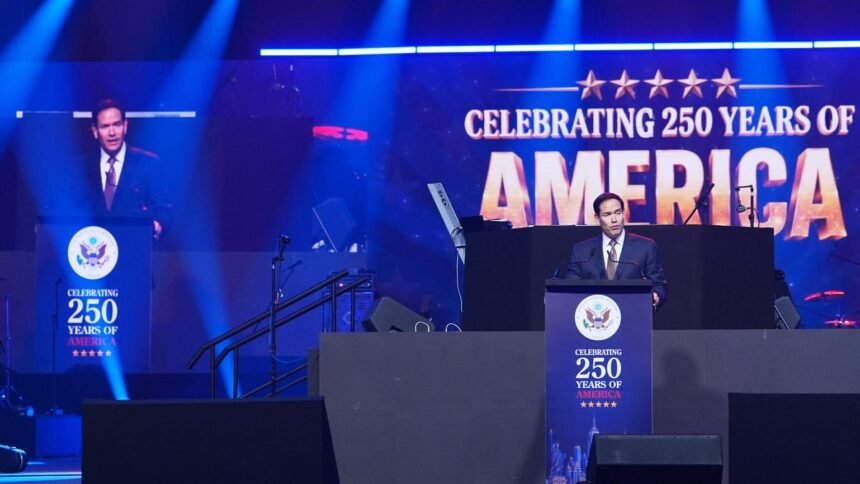
US Secretary of State Marco Rubio in New Delhi on Sunday (May 24) said the United States works with many countries at a “strategic” level, but those ties will not hinder the strategic partnership with India.
Addressing a joint press conference at the Hyderabad House lawn, Mr Rubio said the idea of a “free and open Indo-Pacific” extends beyond the Indo-Pacific to other “international waters” and accused Iran of blocking the Strait of Hormuz while sponsoring proxy terror groups.
Also Read: Marco Rubio Live Updates in India – May 24, 2026
Speaking on the occasion, External Affairs Minister S Jaishankar acknowledged the supply chain disruption caused by the US-Israel war over Iran and said both India and the US have a “very strong interest” in ensuring “secure and uninterrupted maritime commerce”.

“As far as our relations with other countries are concerned, yes, we have relations, and we work at the strategic level, for example, and in many other ways with countries around the world. India does the same. That’s what responsible nations do, but I don’t see our relations with any country in the world at the expense of our strategic alliance with India…,” he said. Mr Rubio was responding to a question at the press conference on Pakistan-US relations, which are being discussed across the world as Pakistan is playing a major role in preventing conflict in the Gulf.
Mr Rubio, who arrived in India on Saturday on a four-day visit, held a one-day meeting with Mr Jaishankar and other officials from the Indian side, including Foreign Secretary Vikram Misri, to discuss energy, bilateral trade and visa issues for skilled Indian workers.
Mr Rubio’s visit to India is the first by a senior US official since the war on Iran began on February 28, killing Ayatollah Khamenei and members of his close family along with several of Iran’s top military figures. The US and Israel at the time stated “regime change” in Iran as the objective of the war. However, Mr Rubio claimed that the war had “clear goals” and accordingly, the US military campaign has destroyed Iran’s navy and “long-range” missile capability, adding that “Iran can never possess a nuclear weapon”.

Giving initial hints about a US-Iran diplomatic settlement that would formally stop the current Gulf war, Mr Rubio accused Iran of sponsoring “proxy groups of terrorists” and called Tehran “the world’s leading sponsor of terrorism”. He focused on Iran’s hold on the Strait of Hormuz as part of asymmetric retaliation since the beginning of the war, which has led to a global energy crisis that has hurt growing economies, including India.
“And look at what they’re doing now. They’ve taken civilian ships hostage, including those now stuck in the Persian Gulf. They’ve laid mines in international waterways. And yet, despite all this, the United States remains committed to finding a peaceful, diplomatic solution to this crisis,” Mr. Rubio said. Iranian Foreign Minister Seyed Abbas Araghchi, who visited New Delhi earlier this month for the BRICS foreign ministers’ meeting, had said that the Strait of Hormuz falls in the territorial waters of Iran and Oman and “there are no international waters in between.”
Both the visiting dignitary and Mr Jaishankar noted the challenges that have emerged in the energy market in recent months and called for an end to the impasse. “We are operating on an open Strait of Hormuz without tolls,” Mr. Rubio said, contradicting Iranian officials, who claimed in Delhi that Iran would begin charging transit vessels for services provided in the strait.

Mr Jaishankar underlined India’s diverse interests covering the strategic and energy sectors. He said India is among the “very few countries” that have “very strong relations” with the US, Israel, Iran and the Gulf countries. However, he cited “the current situation in Hormuz” and said that to deal with the existing risks, it is necessary to diversify India’s energy supply. “Where India is concerned, look, this is the era of de-risking and perhaps energy, more than anything else, requires de-risking… A big country, if you want to de-risk, looks at multiple sourcing, and for us, the United States is a very important source of energy And has emerged as a reliable source, as have indeed some other countries.’
Responding to a question about the Trump administration taking a tough stance on trade relations with India, Mr Rubio said it was not aimed only at India and was a general trade policy that the Trump administration had come up with to counter the “outsourcing-based” economy of the previous US administration.
Mr Rubio began his trip by landing in Kolkata, where he paid tribute to the Missionaries of Charity, founded by Nobel laureate Mother Teresa, and met Prime Minister Narendra Modi. He invited him to the United States on behalf of President Donald Trump. He thanked the diplomatic staff and US Ambassador Sergio Gore and said, “India has committed to buying $500 billion of US goods over the next five years, focusing on energy, technology and agriculture.” Mr Rubio also met National Security Advisor Ajit Doval. The US Embassy announced on Sunday evening that the meeting “focused on counter-terrorism cooperation, regional stability, and strengthening US-India strategic coordination in the Indo-Pacific.”
He will next visit Agra and Jaipur and return to Delhi for the Quad ministerial meeting, where he and Mr Jaishankar will be joined by Japanese Foreign Minister Toshimitsu Motegi and Australian Foreign Minister Penny Wong on May 26.
published – May 24, 2026 11:50 PM IST