
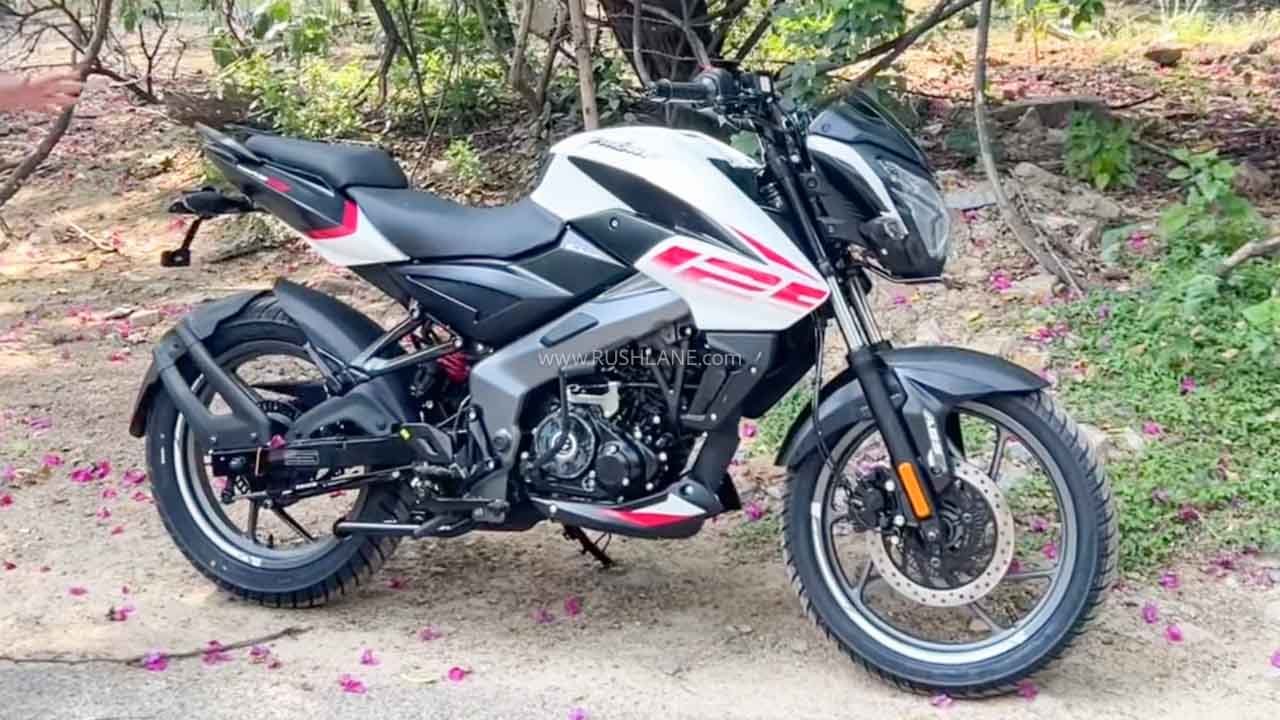
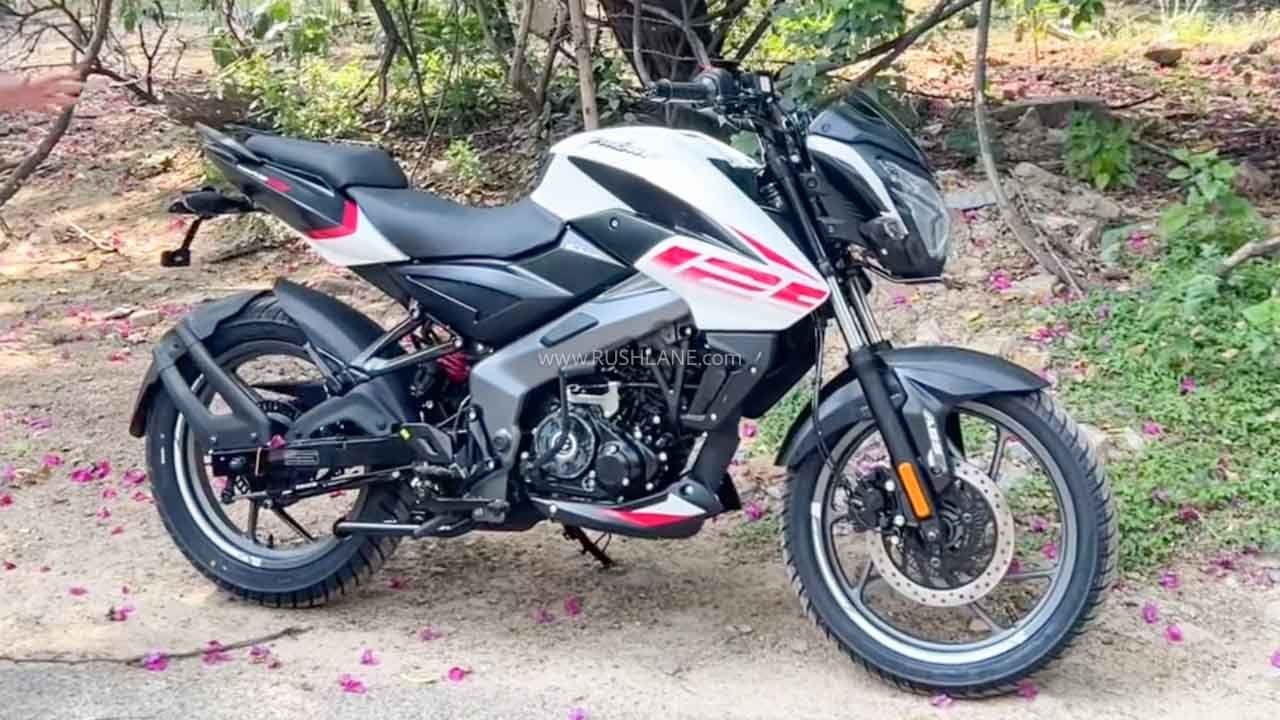
Bajaj Auto reported domestic sales of 2,06,663 units in March 2026, registering a healthy growth of 19.22% YoY as compared to 1,73,343 units sold in March 2025. The growth was largely driven by the strong performance of the Pulsar range and steady demand for the Chetak electric scooter, while entry-level commuter motorcycles continued to deliver volumes.
Bajaj Sales Breakup March 2026
pulsar remains Bajaj’s strongest contributorAccounting for 1,32,248 units in March 2026. This represents a YoY growth of 24.29% with a dominant share of 63.99% in the company’s domestic portfolio. The continuous expansion of the Pulsar lineup across multiple engine segments is cementing its position as Bajaj’s volume driver.
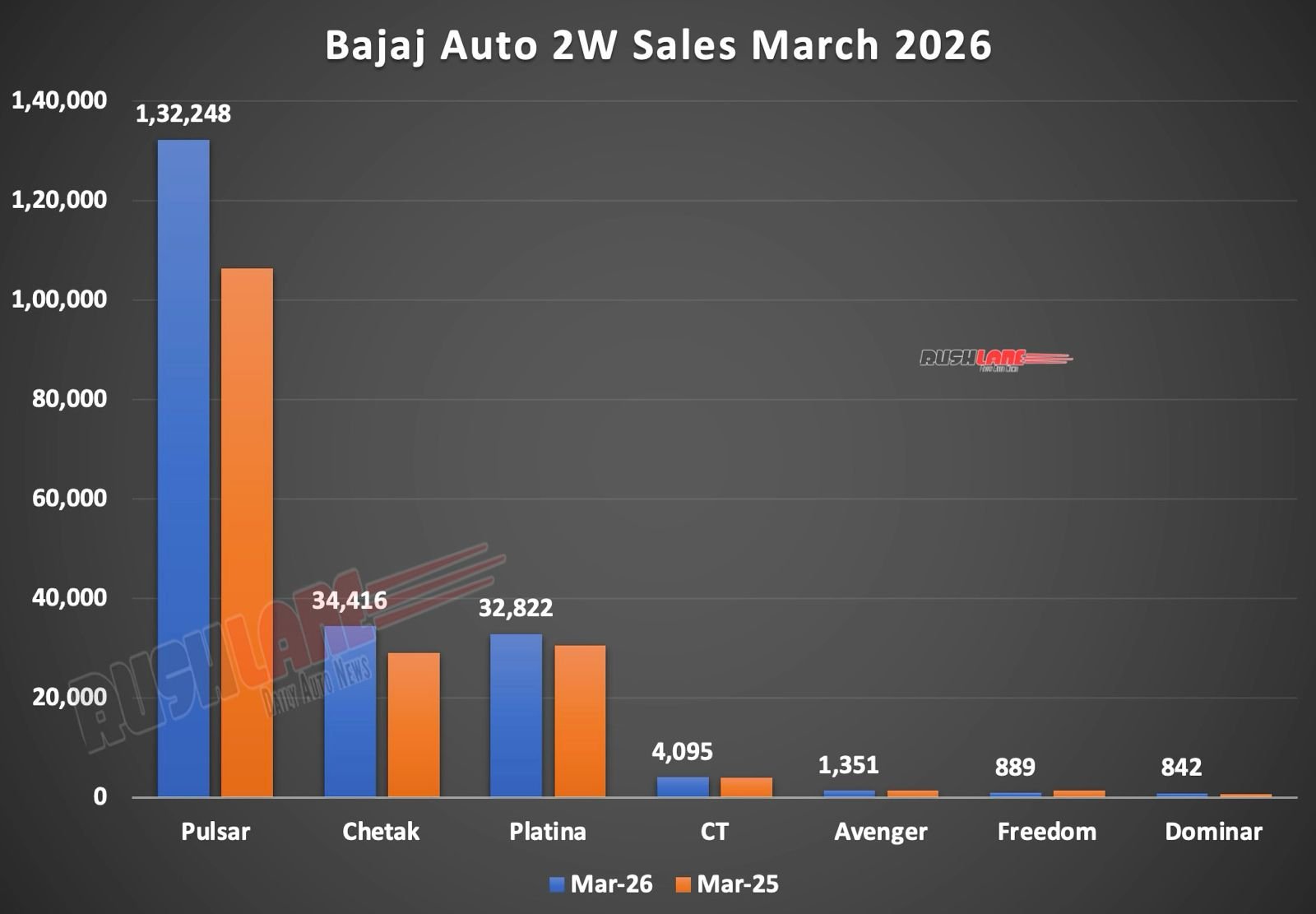
Chetak electric scooter recorded sales of 34,416 units, up 18.75% year-on-year, contributing 16.65% to total domestic volumes. it Highlights the growing presence of Bajaj In the electric two-wheeler sector, Chetak is making steady progress.
Platina continues to be a strong performer in the commuter segment, registering sales of 32,822 units, a growth of 7.19% year-on-year. The entry-level CT range also saw a marginal growth of 5.08%, reaching 4,095 units. On the other hand, Avenger sales declined slightly to 1,351 units (-2.95%), while Freedom declined by 36.23% year-on-year to 889 units. The Dominar range witnessed a positive trend with 842 units sold, up 28.94%, albeit on a lower base.
engine block analysis
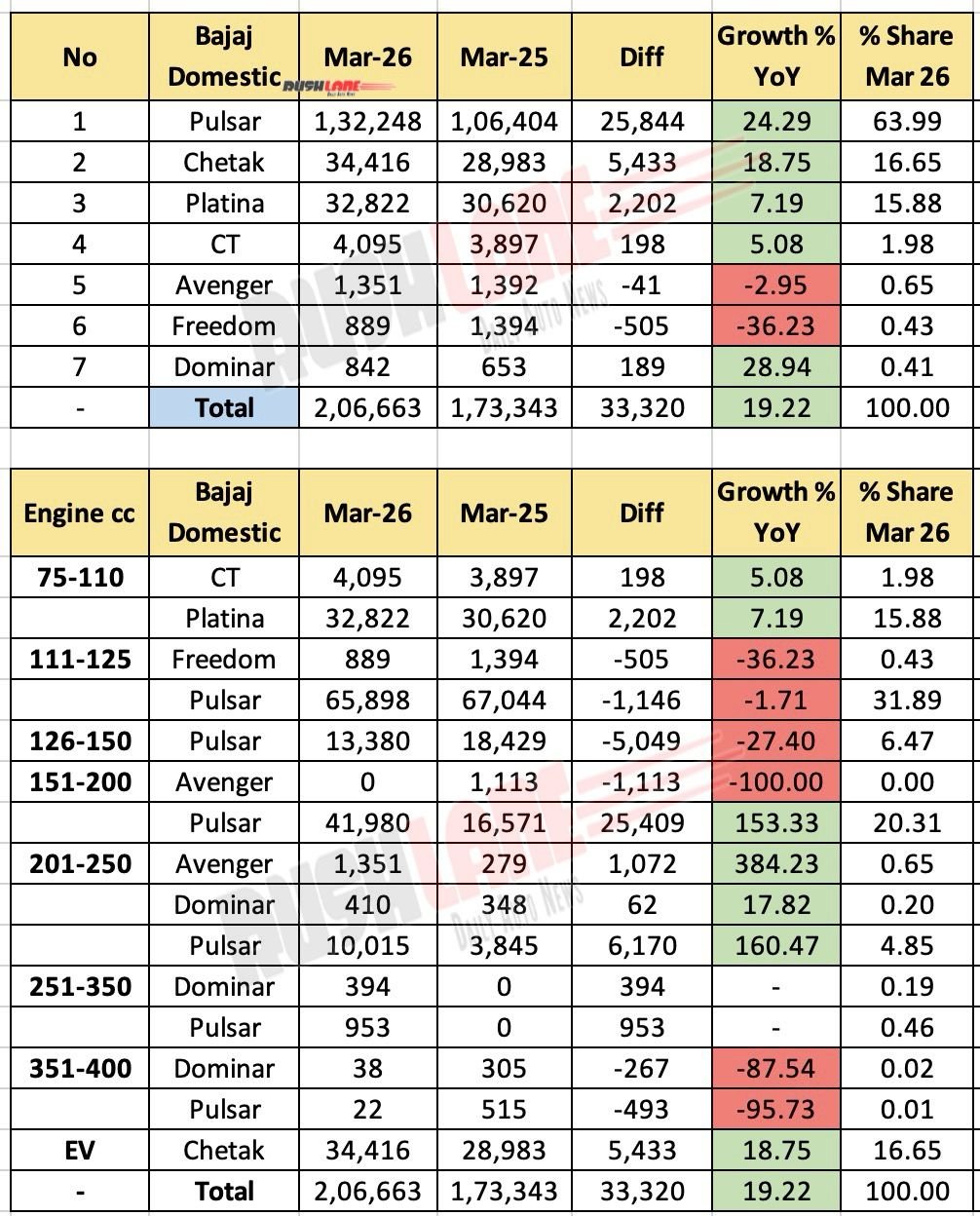
An in-depth look at the engine-wise breakup reveals Clear change in consumer preferences Towards higher displacement motorcycles. In the 75-110cc segment, CT (4,095 units) and Platina (32,822 units) continue to contribute volumes. However, the 111-125cc segment saw a decline, with Pulsar sales seeing a marginal decline of 1.71% and Freedom seeing a steep decline.
The 126-150cc segment also declined, with Pulsar sales declining by 27.40% year-on-year, indicating a gradual move away from the category. Significant growth was recorded in the 151-200cc segment, where Pulsar sales increased by 153.33% year-on-year to 41,980 units. This clearly shows the increasing demand for more powerful motorcycles.
Similarly, in the 201-250cc category, Pulsar registered 10,015 units (+160.47%), while Avenger saw a sharp jump of 1,351 units (+384.23%). Dominar also registered marginal growth in this segment. In the 251-350cc segment, new additions like the Pulsar 350 (953 units) and Dominar 350 (394 units) have started contributing to volumes, indicating Bajaj’s push into the higher capacity segment.
Transition impact in 400cc segment
The 351-400cc segment saw a huge decline, with the Dominar 400 down 87.54% year-on-year and the Pulsar 400 down 95.73%. It is not completely based on demand. Bajaj has recently started shifting its 400cc motorcycles to the sub-350cc category to take advantage of lower GST rates. As a result, sales of these models will gradually move out of the 400 cc category, reflecting a structural change rather than an actual decline in demand.
to sum it up, While Pulsar dominates the volumes, the company is seeing growing traction in high-capacity motorcycles and electric mobility through the Chetak. Also, the ongoing transition of 400cc motorcycles to a lower tax bracket indicates a comprehensive restructuring of the portfolio. Going forward, Bajaj’s focus on premium motorcycles and EVs is expected to play a key role in sustaining growth.