

image source, getty images
published
Reading Time: 6 minutes
On Monday, Taiwan left India behind in terms of stock market valuation.
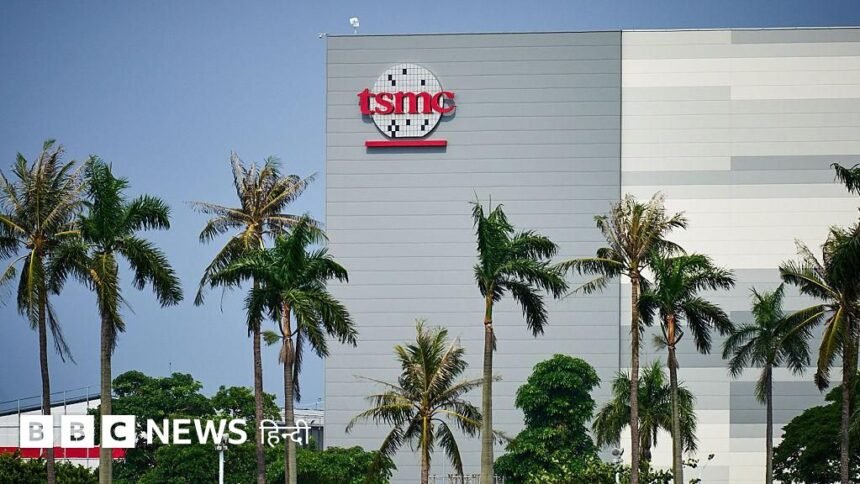
The biggest reason behind this was the explosive rise in the shares of Taiwan Semiconductor Manufacturing Company (TSMC), the world’s largest chip manufacturer.
Stock market valuation or market capitalization is the combined value of the total market cap of all the companies listed on a stock exchange.
For example, the total market value of companies listed on NSE and BSE in India is currently $ 4.92 trillion.
Although Taiwan may have overtaken India in terms of stock market valuation, India’s $4.15 trillion economy, according to IMF estimates, is still much larger than Taiwan’s GDP of $977 billion and is among the fastest growing economies in the world.
But it can also be seen that India with its economy of $4.15 trillion has been left behind by Taiwan with its economy of $977 billion.
bloomberg According to the data, by Monday the total value of Taiwan’s stock market increased to $ 4.95 trillion, while the value of Indian stock markets decreased to $ 4.92 trillion.
Now Taiwan’s stock market has become the fifth largest market in the world. After America, China, Japan and Hong Kong, Taiwan has come. The most interesting thing is that the three in the top five are China, Hong Kong and Taiwan. Hong Kong is an autonomous region of China and China also considers Taiwan as its part.
The main reason for this sharp rise in Taiwan’s global equity ranking is TSMC, whose weightage in Taiwan’s benchmark index Taiex is now about 42 percent.

image source, getty images
Huge surge due to AI
TSMC shares have surged 49 percent this year, taking advantage of the surge in artificial intelligence (AI) as it holds a strong and near-dominant position in the AI-enabled semiconductor market.
The rapid increase in Taiwan’s stock market value shows how positive the environment is globally regarding Artificial Intelligence. This expectation has triggered a rally in technology stocks across the world, with the manufacturing hubs of Taiwan and South Korea benefiting the most.
bloomberg has written that on the other hand, India is struggling with rising energy costs, slow growth in corporate profits and lack of companies with expertise in the field of AI.

“Taiwan’s growing market capitalization fundamentally reflects its huge stake in tech hardware, which is at the center of AI investment right now,” Yi Ping Liao, fund manager at Franklin Templeton Investments, told Bloomberg.
He said, “Markets where tech hardware presence is limited are now being left behind by tech hardware-dominant markets like Taiwan and South Korea.”
The new financial rules have also gone in favor of TSMC. Last month, Taiwan’s financial regulator had increased the investment limit of domestic funds in any one stock.
Under the new guidelines, funds investing only in Taiwanese stocks can now invest up to 25 percent of their total assets in any listed stock whose weightage is more than 10 percent in the Taiex index. Earlier this limit was only 10 percent.
Currently only TSMC meets this criteria. JPMorgan Chase says that this change could bring new investment of more than $6 billion to Taiwan.

image source, getty images
Disillusionment of foreign investors with India
This year, foreign investors have withdrawn their money from the Indian stock market at a record level. Reasons behind this are said to be expensive share prices, weakening rupee and rising energy costs.
So far this year, foreign investors have withdrawn approximately $24 billion from the Indian stock market. The full emphasis of foreign investors is on AI stocks and India currently does not have any strong option in AI.
India’s main stock index Sensex is down almost 10 percent this year. India’s share in the MSCI Emerging Markets Index has also declined from 19 percent last year to about 12 percent.

Just two years ago, India had overtaken Hong Kong to become the fourth largest stock market in the world. But after two years, now Hong Kong is at fourth place and Taiwan has also overtaken India.
It is being said that South Korea can also leave India behind soon. It was already being said that India has lagged behind in the AI race.
This month, global investor and economic affairs expert Ruchir Sharma wrote in India’s leading English newspaper Indian Express Had told, “Now capital is leaving India because today almost the entire focus of the world is on AI.”
“Investors have become crazy about the global race for AI and India is being seen as a weak player in this race. Right now the world is in the “picks and shovels” phase of AI. That means the focus is on semiconductor, memory and computing capability. India is weak in these areas.
Ruchir Sharma had said, “In the last few years, foreign investors have withdrawn 50 billion dollars from the Indian stock market. Net FDI is also almost zero. In my 30 years of investment experience, I have never seen such indifference towards India. There was negativity about India during the “Fragile Five” era of 2013, but today the situation is even worse. Investors are completely focused on AI and India’s weaknesses are now clearly visible.

image source, getty images
Why is India lagging behind?
Ruchir says, “India spends only 0.6 percent of GDP on research, whereas South Korea and Taiwan spend four to five percent.” Israel is at the forefront in the world in this matter. Our IT sector for a long time depended on cheap labor and outsourcing based model, not on innovation and developing new technology. Now this weakness is returning before us as a big challenge.
English newspaper on 20 May Hindustan Times Former RBI Governor D Subbarao had also written that India was lagging behind in technology.
Subbarao had written, “Foreign investors moved their money out of India and moved towards other markets in search of better opportunities across the world. Globally, capital is now being attracted to technology-based economies, especially AI, biotech and data centers. India is still a rapidly growing economy, but its role in these cutting-edge technology areas appears limited. As money is moving towards the innovation economy, pressure on the rupee is almost certain to increase.
Subbarao had written, “India’s foreign exchange reserves are still around $700 billion, which is one of the largest reserves in the world. But this should not lead to over-confidence. In normal times this amount may seem huge, but in times of crisis its real importance lies in its credibility.
Bloomberg has written in one of its reports, “India’s absence in AI-based tech stocks is weighing heavily on it. On the other hand, this situation may worsen due to increasing pressure on the profits of local companies due to the Iran war. According to a report by Crisil Ratings, if the conflict prolongs, corporate profits could fall by about 200 basis points. Airlines, polyester textile, specialty chemicals, flexible packaging and automobile sectors may be most affected.
Published by Collective Newsroom for the BBC.